“The only way I can get her to do it is to yell and scream…and I don’t like that” – How to switch from negative to positive.

photo by martinak15 via Flickr

Recently, I posted an article on the BehaviorBandAid Facebook Page that was intended to be about discipline techniques for children with ADD/ADHD (read it here). I thought the discipline techniques they listed were true for ALL children, so I posted it. The article included a list of common mistakes:

-Not communicating with the child what he or she did wrong (what you need to tell them is what they can do instead…and be specific)

-Flying off the handle

-Failing to follow through

It also included simple reminders and lessons for what to do: Continue reading

Consistent parenting: What you can do to make it easier

photo by OakleyOriginals via Flickr

The signature of mediocrity is not the unwillingness to change but chronic inconsistency. – Jim Collins

If you listen to or read anything about parenting, you have heard about the importance of being “consistent.” What does that mean to you? Does it sound unrealistic…to be able to consistently repeat your actions and your parenting decisions across days, emotions and varying hours of sleep deprivation?

It can be difficult. I will be the first to admit it. In some cases downright tricky. Continue reading

Backseat brawls – How to handle the kids in the car

photo by Will Hale via Flickr

It was pouring down rain and I could hardly see. The windshield wipers barely kept up with the sheets of heavy rain. The only thing I saw was the flashing hazard lights of the car in front of me. People were pulling over.

I plowed through. Wheel gripped tightly, eyes squinted, I plowed through…

because the two kids in the back seat were about to tear each other’s face off. I think they were collaborating with each other to see how much they could annoy me.

There wasn’t a storm in the world that was going to delay me getting home and getting out of the Hell hole that was my vehicle. The kids might be possessed. Continue reading

I hate you…

photo by *clairity* via Flickr

There are times when kids say things that seem like they are meant to hurt…and sometimes  it does:

“I wish I were never born!”

“You don’t love me.”

“You love her more than you love me.”

“I wish I had another mother”

Ouch.

There are some things kids say every day that are easy to ignore. But, there are other times when they go for the gusto. They really cut deep with their words and all of a sudden we loose our grasp on reality and react. Your ears get red, your throat swells, or tears start to well up. It is amazing some of the things a 4 year old can say, but it happens.

It is important to think about this when there is no emotion involved, no thought about whether or not your child actually feels that way, and no inner thoughts telling you your kid might be right. It is important to have a plan and an understanding of why they say these things so you don’t end up teaching them to use these words more.

So, if you are in a fresh state of mind, let’s get a few things clear about why they say these things and what you need to do when it happens.

They don’t know these words hurt. They don’t know why. This is not the way they feel.

Understand that first. Repeat it to yourself in times of distress or when you are questioning yourself.

Are you sharpening the tool or making it dull?

Your kids use these words for a reason. The words are tools…a last ditch effort when all else has failed. It is an escalation in most cases, but an immediately strong reaction in others.

It might be a sign that your kid’s “attention cup” is running low. It might be the case they are telling you, “but, I really, really want that Transformer and you don’t seem to care how much I want it.” Either way, you do not need to attend to it when it happens.

If you attend to these statements, you will likely teach your child how powerful these words or statements are. Be very careful.

For example, if you have ignored simple attempts at getting your attention, but then your daughter gets upset and says, “you NEVER play with me” and then you go and play, guess what just happened? Yep…you have taught them a very effective and efficient way to get access to you, NOT in a way you want them to.

It is about timing. If your kid is more able to get your attention after using these words than before they said these words, you are going to be in trouble.

There is a time for everything

And the time to reassure them about your love, affection and care is not when they say these things. It can be once they calm down or once they are reasonable (as reasonable as a 5 year old can be). You can even say something like, “I am glad you are calm now, did you want to read books with me or color in the den with me?”

Of course, and most importantly, if you maintain consistent attention, affection and reinforcement to your kid, you can better be prepared to ignore these statements and move on.

And remember…

Try to anticipate these things as they are likely to happen again and understand you dont want to be in the place again to have to ignore these comments. They are powerful. They hurt. Make sure you do as much as you can to not have to hear these words again.



Newsflash: Your child will be upset at some point…and its OK

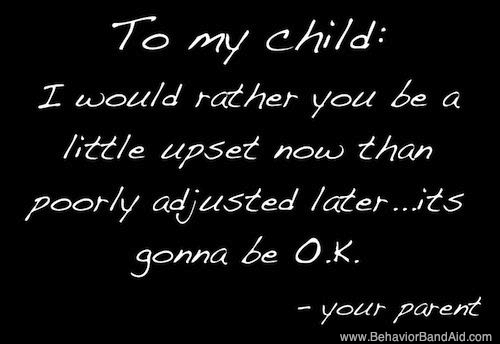
I posted this picture on the BehaviorBandAid.com Facebook Page and several people liked it, so I thought I would share it directly here.

I think what it says is simple: there are going to be times in everyone’s life (including your kid’s) when things don’t go right or you don’t get exactly what you want.

The way you respond to this will ultimately teach your children how to handle this in the future. Will they be dependent on you to get through the tough times? Will they have a paper-thin tolerance for frustration? Or will they push through, persevere, and be resilient?

Check out these previous posts for more on this…

Too comfortable: a parent’s unending determination to maintain “comfort”

“Daddy, should this hurt and make me cry?” How to teach drama

Is your home a balloon factory?

The skeleton key: what behaviors open doors?

Good grief! How long is does it take you to do that?!?

Photo by Aniket Thakur via Flickr

Sometimes the most important things can be the hardest to notice…getting dressed and ready in a timely manner is one of them. Here are some things to do about it.

7:25 pm –

Walking out of the room where my child stands naked after taking a bath, I quickly say, “Alright, man…here are your pajamas. Go ahead and get dressed.”

From Thomas the Train undies to the Toy Story PJ set, this is a 2 minute task…OR SHOULD BE.

Ten minutes later I open the door ready to read the bedtime story and all I see is our son in some naked Yoga pose over a set of trains perfectly lined up on a new track (like, “new” in the last 10 minutes “new”). “Why are you not dressed yet?” I ask, not expecting an answer I would approve of.

Why this is important

I tell this story because it reflects two bigger issues I think we all deal with as parents:

1. We often forget to notice and reinforce behavior that doesn’t seem really great, but really makes a difference when it doesn’t happen (i.e., there is a big difference between a morning before school with a kid who gets ready on time vs. one who messes around and requires constant nudging to get ready).

2. When kids are slow in doing something you want them to do, they are simply being kids. The behavioral explanation for this is there are competing reinforcers. This is not hard to understand, but sometimes difficult to get through. I will help you out.

Hard to notice good behavior

Simply stated, there are a lot of behaviors that are just not that noticeable, like getting dressed in a decent period of time, picking up something when dropped, closing a door instead of slamming it, NOT freaking out when told “no.” Sometimes we refer to these as the should behaviors (i.e. “he should be able to do that”) and other times the behaviors are nearly impossible to notice (e.g., a flushed toilet, socks put away, having a bookbag put together).

Do this today…yes, you

Sit down and make a list of these behaviors that happen frequently enough, but when they don’t happen, it really annoys you or it causes a hitch in your day. Put this list somewhere that will help remind you to pay attention to these things. Remind your kids before the behaviors happen (i.e., right before they are getting dressed, when you know they are about to go to the bathroom). When it happens, pay attention to them…praise them…thank your kids for doing these things.

Sounds simple. It is. It is as important as it is simple.

Find more powerful motivation if you need

I have written about competing motivations before, but it is worth mentioning again. If your  kids are consistently dragging and taking forever to do things, you might need to set up some other reinforcers or things to motivate them at the time these things usually occur.

Make sure the requirements/criteria are clearly stated (written on a list for older kids). This can be something as simple as a special breakfast choice if ready for school before a specific time (state the time and use the clock in the kitchen) or as easy as “as soon as you finish getting dressed you can _______.” You could even read the posts on token systems and use something like that for these times.

Try to make the reinforcer/reward as close to the behavior occurring as possible. The quicker the fun thing occurs after the behavior occurs, the better it will be. For older kids, can you get away with something special after school for a job well done in the morning before school? Yes, but it will not be nearly as effective as something that they get in the morning.

Hopefully things will speed up a bit for you…having the night-time 10 minute episode of Thomas the Train turned on when we leave the room at PJ time sure has sped up our little man.

“Zoom out” in times of distress


photo by alexindigo via Flickr

I have often thought parenting is like climbing a mountain: ups and downs, tricky turns, sometimes going down a little to go up and sometimes slowly navigating slippery passages. All of these trying times, however, come with incredible feelings of accomplishment at every “peak.” After listening to a recent interview with a famous author and mountain climber, I’m even more convinced.

Climbing mountains and “Zooming in” on the problem

Jim Collins, the coauthor of the book Great by Choice,  is a mountain climber. He talks about times when you get a not-so-great grip during a climb and things start looking bleak. He says climbers (ahem, ahem: parents) tend to “zoom in” on the problem, trying to find a way to get a better grasp; clinching and gripping even tighter to that bad hold. With each slight move of a finger or shift of weight in an effort to make that grip better, the problem gets worse and worse. Ultimately, if the climber can’t break out, he falls.

Undivided focus is given towards the weakening hold: the problem

Zooming in on the problem puts undue attention on the problem, rather than the solution. Teeth are mashed, knuckles are popping, and fingertips loose pressure. Bad goes to worse.

However, if the climber could simply zoom out instead of zoom in, he or she would notice the better foothold or another better grip position. Moving in any of these other directions immediately alleviates all the problems being encountered. However, if completely zoomed in on the problem, the solutions are not visible.

Are there times in your role as a parent you focus too much on the problem rather than the possible solutions or bigger picture?

I see this sometimes in a wide variety of situations where the parent gets so deep into trying to “follow through” or “make sure the child doesn’t get away with it,” that the parent is almost ensuring the behavior will escalate and cause a much bigger problem than it was in the beginning. I have heard parents say, “if he does not clean his room after I ask two or three times, I’ll go in there and MAKE him do it.” What does that mean? You are going to force it and create a bigger mess than the room ever was? ZOOM OUT, for crying out loud!

I have seen parents get so frustrated with making sure their kid does what they say, that they end up having WWIII when, if they would have gone about things differently, there would not be a problem in the first place. Adding punisher after punisher until something finally hits so hard the child submits. Physically engaging at the point of total frustration. Both parent and child typically leave this situation embarrassed and emotionally drained. I get it…it happens to all of us.

Zoom out!

Zooming out in these situations means stepping back and asking questions about why he is not cleaning his room and how you can make it more likely next time. It is about asking why she always dilly-dallies around in the morning instead of being ready on time and how you might could motivate her to move quicker and more independently in the future. It is about why YOU react so strongly in some situations and how YOU can better prepare for (or avoid) them in the future.

Put up notes around the house, put something on the fridge. Whatever it is you need to do to remind yourself to ZOOM OUT in times of distress or difficulty. Enlist your spouse to tell you to “zoom out” when things are getting tough. Look for other options. Don’t fall off the cliff because you wanted to make that one grip hold. Make it to the top because you found better solutions once you got into trouble.