Is your home a balloon factory?


One of my favorite authors, as I might have mentioned before, is Seth Godin.  He has a pretty incredible following and the ability to speak about problems and work place challenges in a very effective way.  In his book, Tribes, he uses the metaphor of a balloon factory in describing how some businesses operate.  He describes it as a place where the workers are “timid” and “very concerned about pins, needles, and porcupines.  They don’t like changes in temperature.  Sharp objects are a problem as well.”  His point is that a lot of places are too concerned with maintaining the status quo and get freaked out when a unicorn shows up at the door (something that will ultimately disrupt the status quo of a balloon factory as you can imagine, but could result in great lasting change).  What if the status quo sucks?

So, I will ask you again:  is your home a balloon factory?  Are you more concerned about avoiding the next tantrum, the next fit, the next fight between siblings and keeping everyone content at the expense of true, good behavior change?  This is not a question about prevention, as clearly I am a big fan of prevention strategies as a main component of successful behavior management.  What I am talking about is the running around, anxiety filled day you have trying to keep everyone soothed when there is a problem.  Picking up the whining child, running to the store at midnight to get more Cheerios because “Timmy will freak if he wakes up to no Cheerios,” solving each sibling disagreement as it occurs, ordering that movie you said you would not order, just to get a break.  

Do you have to do it a lot?  Does it seem to consume your day?  Do you feel like a fireman continually dousing flames and occasionally having to rescue the family dog from a 4-alarm fire?  Exhausting…and guess what?  You are not making things better and are likely making things worse by appeasing your kid’s every wish, every whine, every complaint. 

Let me be your unicorn (that sounds weird, but I like the metaphor).  Real behavior change takes work and could potentially result in some balloons being burst.  That’s OK.  The good news is that it will get better, not worse, with the right tools, effort and consistency.

“There’s a sticker chart on my fridge and I don’t know why:” Sticker charts 101


Wow…I wish it were as easy as it sounds.  It seems easy enough, right?  Find behaviors you want to increase, reward them with a sticker, smiley face or check in the box and magic happens.  One of the first major mistakes I made in my career was suggesting much too often the use of “sticker charts” or “token systems.”  The reason it was a mistake is these systems are far more intricate and difficult than they seem.  I’m not trying to be over-the-top, but it is important to know what you are doing before you do it if you want lasting effects.

This topic is so popular, I have to put this together in several separate posts.  For the time being, here is a list of dos/donts, warnings and recommendations regarding token systems.  For purposes here, I will refer to all of the different forms of tokens/ stickers/ smileys/ checks/ etc. as “tokens.”

  • The most important factor is the connection between the “token” and what can be accessed with the tokens.  What I mean by this is the amount of times the tokens are “traded in” for something bigger, not the amount of times tokens are delivered.  For example, “as soon as you get 10 smiley’s we can go for ice cream.”  This is what makes the tokens valuable.

These systems fail for the following reasons:

  1. Not enough connections between the tokens and the bigger reward at the end
  2. Tokens not delivered frequently enough
  3. Final reward is not valuable
  4. Parents stop paying attention and stop using them
  • It has nothing to do with what the “token” is.  A colleague once taught teachers that pocket lint could be effective tokens if you do it right…its all about the connections making those tokens mean something other than what they are (round pieces of plastic if we are talking about tokens or poker chips).
  • How many tokens should he have to earn?  It depends on how frequently you want to deliver the final reinforcer and how often you plan on delivering the tokens.  Since “connections count,” the benefit would be to set something up that can be earned pretty frequently so you can deliver the tokens as freely as you can.  If this is the case, I like more (not more time, but more opportunities to praise and respond to the behavior).  Beware of the feasibility factor.
  • Determining the number of tokens that need to be earned to access the big reward is also sometimes determined by the opportunities for the behavior to occur.  There are less opportunities to reward pooping than “being polite,” for example.  Something like “pooping in the potty”, I am more willing to immediately reward with something else because you simply don’t get that many opportunities within a day. 
  • Feasibility factor.  This is where parent burn-out comes in.  Don’t start a program you are not going be able to maintain.  For example, “I’ll give him a sticker every time he says thank you.”  This won’t happen.  It will occur too much and you will not keep up with it.  Remember, make a considerable effort, but don’t kid yourself.
  • Quick first, then fade away.  Remember: connections count.  You are building value into the tokens so they can soon be rewards themselves (that is the point, by the way).
  • Make it specific behaviors.  Stay away from “being good.”  Not specific enough.
  • Availability of final reward is important.  Better to make it immediate.  What I don’t want to happen is for the child to earn the last token then have to wait a few days to get it, especially if he acts terribly between earning it and getting it.
  • Stay away from “if you do this every day this week, then on Friday you can…” This reduces the chances to make the connection to one time a week. You miss one week and the reward isn’t redeemable for a whole other week.  For example, “as soon as you get 5 tokens” rather than “if you get 5 tokens by Friday.”  The first allows you to always be working towards the goal.  The latter only gives you that one opportunity on Friday (and probably makes you change the rules, which sucks).
  • Taking away tokens?  Be careful…it can ruin the positive side of this.  Remember: connections count.  This is a reinforcement program, not a punishment program.

You are not alone…I “Googled” for you

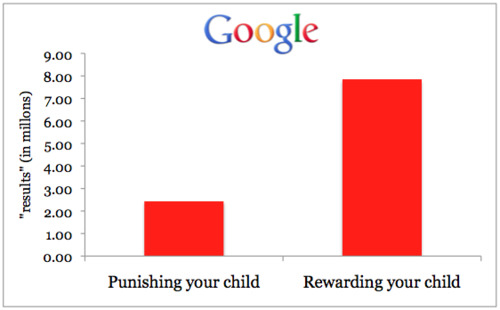
Just for a bit of fun, I wanted to know how much information there is out there about popular parenting topics.  One way to measure this now is simply to see how many websites provide information on whatever it is you want.  Its a way to see how much interest there is in something: Google it.  

Here are some results from a recent Google search I did in your honor.  The phrases below the columns are what I “searched.”  What I think it shows is

1) There is a lot…A LOT out there

2) There is a lot out there because the interest and thirst for the knowledge is great

3) If you are “Googling” for help or information on these topics…you are not alone.


Looks like you have company…

“1…2…2 and a haaaalf….don’t make me get to 3”


If we could put together a top ten list of common parenting phrases, I think counting to 3 would be near the top.  “Don’t make me come in there,” “what was that noise?” “you’re awfully quiet in there” are probably in there somewhere too.  

Counting to 3?  Really?  What is that?  You want my answer?  Here is what your child hears:

  • “Its OK for you to continue doing that until I get to 2 and a half, so wrap it up, but don’t be in a hurry.”
  • “I might or might not get to 3 and will usually ask you if you want me to get to 3 before I actually get there, so carry on.”
  • “The counting has less to do with time than it does with my current level of patience.” 
  • “Getting to three really depends on how quickly I can physically get to you, so the further you are away from me, the less likely I will get to 3 or actually be able to follow through with what 3 means if I do get there.”
  • “Oh, and by the way, I don’t know what the ‘or else’ is quite yet.”

Do you count to 3?  How many times do you get to 3?  Do you find yourself using this a lot?  The more you use it, the less it is working, by the way.  I want your directions to mean something other than what you are probably teaching by counting to three. Here are some quick to dos:

  • Before you ask your child to do something, be ready for both responses (he is either going to do it or not…its pretty predictable).
  • If she does what you ask, praise and reinforce socially… “thank you for listening and picking up your shoes”
  • If she does not do what you ask, be close enough to follow through by taking her (nicely and calmly) to her shoes and saying, “OK, give me that shoe, please.”  This takes the place of being further away and saying, “you need to pick those shoes up before I count to 3!”  Reinforce and praise when she does it, even though you are there making #$% sure she does it.
  • If you ask 5 times then say, “this is the last time I am going to ask you,” do yourself a favor and be there for the follow through as close to the first request as possible. 

You might be amazed at how much more compliant your children are when you actually follow through with your initial requests, both positively and correctively.

Your child is texting you…


We have all learned to reduce our writing to the bare minimum to effectively communicate through txt msging. Some of these messages are so reduced we need a glossary to figure out what the other person has written.  Some have made their way into normal lingo (ex. Lol, omg), but others are a bit more obscure.  Here are a few things I think your young child would send along via SMS:

IMOK = I am O.K. 

My tantrum was simply because I did not get what I want.  

IDNTH8U = I don’t hate you.

I just say it for the effect.  When I say it you somehow forget what we are doing, tell me how much you love me and ask, “why would you ever say that?”  Sometimes, when you don’t do this, you say, “OK, I’m done with you” and walk away…which is what I wanted you to do in the first place. 

IMTRD = I’m tired. 

You can’t tell this because I am acting possessed, running around and screaming, but think about what we have done today…get me to a quiet place and let me sleep.

IDK = I DO know.

I just don’t want to tell you and really would rather not talk about this at all. 

IWTO = I want time out. 

This follows your question, “do you want to go to time out?” REALLY? Do I have a choice?  Why are you even asking me in the first place?  I’m 4 years old!  Is there really a right answer to this?

OMG = Ouch, my gut. 

I feel horrible today.  How do you act when you have stomach aches and poop in your pants?  Thought so, ease up on me today. 

ICDI = I can do it. 

I really could probably do it if you took the time to teach me and let me do it.  I mean, do I just automatically learn this stuff, or does it take you being tired enough of doing it to finally teach me?  Don’t wait.  I can probably do this now.

AMA = Acting my age. 

This is not going to last forever.  My behavior problem today is not pathological.  Pay attention, but relax.

One (more) reason “Saved by the Bell” was awesome


If I have correctly identified the age group of the audience of this site, all of you remember this legendary after-school television masterpiece. Zach, Kelly and the crew.  Ah, the memories.  Without getting too sentimental, or exposing myself as a devoted fan of the show (oops, too late), there is one thing in this show I always wanted then, but something we could all use much more now: the pause button.  Remember that?  Zach would find himself in a precarious position of who to ask to the prom or how to pull a fast one on ol’ principal Belding and he would look at the camera and say “PAUSE!” Everyone around him would freeze and become a statue.  Zach would review the situation, weigh out the pros and cons, maybe provide a bit more insider information then would magically snap his fingers and those around him would continue on as if nothing happened, not a second lost.

In my effort to teach parents to teach their children to be better at following directions or to become more “compliant,” I often bring up the idea of a “pause” button and how it can help us better teach compliance. 

Before you ask your child to do something or to stop doing something, I want you to “PAUSE.”  Ask yourself, “what are the chances he is going to follow that direction?”  If the chances are less than 80-90%, you need to figure out a better way to give that direction, a better time to give it, a better position from which to give it, or somehow change the way you ask to make it more likely he will respond appropriately.  Why? 

Shouldn’t our children just do what we ask them to do?  YES.  That is what I am trying to do.  I am trying to make sure when you ask your child to do something, it actually means something.  Think about it: the more directions you give that are not complied with, the more experience your child has ignoring your requests—you are teaching noncompliance by giving poorly timed and controlled directions.  Think about it in terms of the ratio of your requests:


Directions given : Directions followed


Your job is to make this ratio as close to a 1:1 relationship as possible.  Don’t expect the ratio to get closer to that magical number by punishing the noncompliance.  Expect it to get there by preparing appropriately and reinforcing the compliance.

Do yourself a favor and hit that pause button every now and then…who said watching “Saved by the Bell” was a waste of time??

“For the last time…you can’t drive to the beach!” A lesson about ridiculous arguments.


Fairly frequently, I hear about children who are “argumentative,” will “argue for hours on end” or “will not stop arguing.”  This is common enough to talk about.

Here is the news:

1.    It takes at least 2 people to have an argument.  If your child is arguing with you, you are also arguing with your child.  What you are doing and saying is maintaining the argument.

2.    A lot of times, the child is arguing about something you control (access to a certain food, money, permission to have a sleep over, not going to school, etc.), so he needs you visible and engaged to get access to what he wants.  Your engagement/arguing signals the continued availability of the item.

3.    Sometimes, the arguments work (access to those things he wanted, but were not allowed prior to the argument itself).  If the argument gets “solved” after an hour, the hour-long argument has been taught…by you (see the post about kicking the soda machine).


Think about these things if you find you have an attorney in training (no offense): 

1.    If you control what the child is arguing about, leave it.  If a 15 year old is arguing about driving to the beach and you have the keys to the car, why go into some diatribe about being 15, not being responsible enough, against the law, etc.  YOU HAVE THE KEYS…ITS NOT GOING TO HAPPEN.  This is even easier with younger kids.  “I want gummy bears! NOPE.  (They are in the top of the cabinet where she can’t reach them…why argue about it?)

2.    Don’t let an argument be a “skeleton key.”  Arguments should not open doors that were not open prior to the argument itself.  Otherwise, it has been effective even if the initial request is not granted.  For example:

CHILD: I want to go to Lizzie’s house to spend the night

PARENT: No, not tonight

CHILD: WHY?!?

PARENT: Because I said so

CHILD: [Increasing intensity, “I hate you,” “I never get to spend the night,” “Lizzie’s mom is cooler than you,” etc.]

PARENT: I tell you what…do you want Lizzie to come over here tonight?

CHILD: Sure mom, can we go to Pizza Hut?  I LOVE YOU MOM.

Think about this next time your child is hysterically arguing about not being able to get that pizza delivered for breakfast instead of explaining why you shouldn’t eat pizza for breakfast and giving him the option to order it for lunch if he stops complaining.