A game of tug-of-war, and you’re in the mud


Here is a common strategy:  child misbehaves, parent takes away TV, child continues to misbehave, parent takes away Playstation, child continues to misbehave, parent takes away iPod…you get the process.  It happens a lot.  What also happens a lot is parents coming to me saying, “I have taken away just about everything he likes and it does not seem to be working!” 

Amazingly, these parents will continue taking things away (often things of lesser and lesser value to the child) knowing its not working, but hoping there will be one time when the kid turns to them and says, “OK.  I’m sorry.  I get it now.  I will stop screaming at my sister.”  How often does that happen?  Not often (I’m being nice).

Here are some ideas and notes about these strategies, what to do and what not to do.  Some of this I have mentioned before, but is worth repeating in this context.

  • Avoid this “taking away” strategy altogether…hmmm, now that was easy.
  • Control access to these preferred items (i.e., keep the Wii controllers out of their reach) and activities and offer access to the child when they have done well rather than taking them when they have not.  All you have to do is deliver…nice and easy and on a daily basis.  
  • Please do not engage in a physical tug of war over something.  Please.  Don’t grab the controller, the video game, etc. in a fit of emotion or argument.  This is especially for older children who might fight back.
  • Do not take away something that you ultimately do not control.  For example, don’t tell your child he cant go outside until he finishes his homework, unless you can make sure he cant go outside.  For the older and more gutsy kids, they might try to go outside, even when you told them not to.  If you can’t control it, I wouldn’t use it.  I would hate to see you take the Wii away, not get the controllers, then come into the living room to find your son and daughter in a competitive game of Guitar Hero. Smoke is coming out of your ears and he just showed you up.
  • Make sure there are specific criteria for earning access to these things.  Not, “do a good job,” but “all socks in your drawer and your underwear off the fan.”  Not, “until I say you are done,” but “when you have completed each one of your math problems with 80% accuracy.”

Leave the rope where it is…you have lost every time anyway.

Poker chips and Pesos: Sticker charts 2.0


Recently, I started a conversation about the ins and outs of token systems/sticker charts systems.  However, there is so much to be said about “token systems,” “sticker charts,” etc., I needed a bit more space to fill in some of the gaps. Here is some more background that needs to be said.  

Token systems take advantage of several things to help improve behavior.  One of the basics is that we are associating a seemingly neutral thing (a piece of plastic we call a poker chip, a random mark on a page called a check, or an oversimplified image of a happy person’s face, etc.) to something that is valuable (candy, time on Wii, movie night, etc.).  Two very powerful versions of this concept are money (pieces of colored paper we trade for things we want and need) and poker chips.  These things are only valuable on their own because what we can get with them.  Think of it this way…lets take away the connection to value and see what happens:

  • You are home recovering from your trip to Vegas and, amongst other things you don’t want to talk about, you find a few chips in your suitcase.  What do you do with these?  Kid’s room as a toy or stashed away as a “souvenir.” Right?  Why?  It’s not valuable anymore other than as a novelty because it can’t be traded in for anything.  Again, that chip goes back to its roots as a piece of standard plastic.
  • You are home from your second honeymoon in Mexico and, in between swigs of Pepto, you run across several Pesos.  Same thing happens…the money goes to school with the kids as a “show and tell” or gets stowed away in a photo album next to those cool Mexican beer labels you tore off on your last night on the town.  It’s not worth anything anymore because it cannot be traded for other things easily.  When was the last time you put a $10 bill in a photo album?  

A common misunderstanding about these systems is that is it all about the token itself.  I have heard parents say, “the stickers didn’t work, but the Dora stamps did for a while” or “anything works for about a week, but then it stops working.”  Obviously, there are several reasons why it could have stopped working, but chances are the novelty of the “token” wore off because it wasn’t connected to anything valuable beyond the initial value of that cool stamp or the new CARS 2 stickers on the fridge.

The lesson: the tokens are only as powerful as what they are connected to and how available those things are.

“I get so emotional….”


e – mo – tion: noun

An affective state of consciousness in which joy, sorrow, fear, hate, or the like, is experienced, as distinguished from cognitive and volitional states of consciousness (www.dictionary.com)

Does that say what I think it does? That emotional responding and thinking are mutually exclusive? “Distinguished from cognitive?”  You can’t think while being emotional?  I think it does…and I think this has so much to say about parenting.

Emotion plays a huge role in parenting.  It is the spice of life in many ways. BUT, lets face it…we are horrible decision makers when we are acting on emotion or in the “heat of the moment.”  Some of our worst decisions are made when we are emotional, in either direction.  How many times have you reacted differently to your child because of the way YOU felt, not the way HE behaved?  That’s what I’m talking about here…

Depending on the age of your child, you probably know the things she does to get herself in trouble.  The things that really make you red in the face and make you want to scream (or actually scream).  Emotion should not play a role here.  You need a plan:

  • Given these are “hot button” experiences for you, go ahead and make decisions about what you are going to do when it happens.  AHEAD OF TIME.  
  • For example, when he hits his sister, “I am going to take him to his room,” “when he spills his milk, I’m just going to ask him to clean it up,” “when he has a huge tantrum in the middle of the kitchen, I’m going to go to the den and read a magazine,” “when he freaks about leaving the store, I’m just going to leave and not threaten to take away toys.”
  • Discuss this with anyone else who is responsible for your child and who might experience similar experiences.
  • Follow your rule.  You have already made the decision based on sound and logical thinking.  

Much better.  Go be mad somewhere else.

Parent myth busting: Bribery vs. Rewards


I read a recent article on Parenting.com about parenting myths and want to clear up something about what the author calls “bribery.”  Nothing against Ms. Newman, described as “popular and edgy.”  She writes well (clearly, as she is published in a lot of cool places), but she’s a freelance writer and a film producer.  She has some good points and includes professional opinions, but I need to clarify one of her points a bit further from the professional behavior analyst side of things.

There is a difference between reinforcement strategies (we can use the word rewards here if you like that better) and “bribery.”  It really is an issue of timing and planning. Here is a quick example to differentiate the two, and to explain why bribery, as I define it here, can get you in trouble:

BRIBERY: You go into Wal-Mart at noon on Sunday with your kid in tow.  After the turn down the frozen food section aisle, you kid starts wiggling and complaining.  

 PARENT:  “STOP IT.” “SIT DOWN.” “STOP.” “SHHHH.”  

CHILD:     “BUT, I WANT THE ICE CREAM SANDWICHES”

PARENT:  “Not if you are acting like this.  NOW SIT DOWN!”

CHILD:     “AHHHH!!!!  BUT I WANT THE ICE CREAM SANDWICHES!!!”

PARENT:   “NO! SIT…SIT DOWN!   ——-     SIT DOWN!

 CHILD:      “NO! I.    WANT.    ICE.   CREAM!”

PARENT:   “O.K., If you sit down and be quiet, I will get you your ice cream sandwiches”

Did you see what just happened?  The ice cream sandwiches only became available after the bad behavior as a ploy, A BRIBE, to get that child to sit down and be quiet.  The child probably sat, but this is not good. 

REINFORCEMENT:  Same scenario…different outcome short and long term.  

Conversation begins in the car:

PARENT:  “OK, We are only going to get a few things, so we will be in and out.  If you can hold my hand, sit in your seat and use your inside voice, we can get ice cream sandwiches on the way out.”

                                       Fast forward to the store

PARENT:  “You are doing a good job sitting in your seat, we are almost to the ice cream sandwiches!”  

CHILD:     “Can I get chocolate?”

PARENT:  “As long as you keep sitting nice and quiet”

CHILD:     “HEY!  There are the ICE CREAM SANDWICHES!!!”

PARENT:  “You did a good job, Grab those chocolate ones!”

See the difference?  Now, I made the examples clearly different.  It will not be 100% compliance every time you set it up, but at least you have communicated what gets the ice cream sandwiches and what doesn’t, BEFORE THE BAD BEHAVIOR OCCURS—-THAT’S THE POINT.  

Is your home a balloon factory?


One of my favorite authors, as I might have mentioned before, is Seth Godin.  He has a pretty incredible following and the ability to speak about problems and work place challenges in a very effective way.  In his book, Tribes, he uses the metaphor of a balloon factory in describing how some businesses operate.  He describes it as a place where the workers are “timid” and “very concerned about pins, needles, and porcupines.  They don’t like changes in temperature.  Sharp objects are a problem as well.”  His point is that a lot of places are too concerned with maintaining the status quo and get freaked out when a unicorn shows up at the door (something that will ultimately disrupt the status quo of a balloon factory as you can imagine, but could result in great lasting change).  What if the status quo sucks?

So, I will ask you again:  is your home a balloon factory?  Are you more concerned about avoiding the next tantrum, the next fit, the next fight between siblings and keeping everyone content at the expense of true, good behavior change?  This is not a question about prevention, as clearly I am a big fan of prevention strategies as a main component of successful behavior management.  What I am talking about is the running around, anxiety filled day you have trying to keep everyone soothed when there is a problem.  Picking up the whining child, running to the store at midnight to get more Cheerios because “Timmy will freak if he wakes up to no Cheerios,” solving each sibling disagreement as it occurs, ordering that movie you said you would not order, just to get a break.  

Do you have to do it a lot?  Does it seem to consume your day?  Do you feel like a fireman continually dousing flames and occasionally having to rescue the family dog from a 4-alarm fire?  Exhausting…and guess what?  You are not making things better and are likely making things worse by appeasing your kid’s every wish, every whine, every complaint. 

Let me be your unicorn (that sounds weird, but I like the metaphor).  Real behavior change takes work and could potentially result in some balloons being burst.  That’s OK.  The good news is that it will get better, not worse, with the right tools, effort and consistency.

“There’s a sticker chart on my fridge and I don’t know why:” Sticker charts 101


Wow…I wish it were as easy as it sounds.  It seems easy enough, right?  Find behaviors you want to increase, reward them with a sticker, smiley face or check in the box and magic happens.  One of the first major mistakes I made in my career was suggesting much too often the use of “sticker charts” or “token systems.”  The reason it was a mistake is these systems are far more intricate and difficult than they seem.  I’m not trying to be over-the-top, but it is important to know what you are doing before you do it if you want lasting effects.

This topic is so popular, I have to put this together in several separate posts.  For the time being, here is a list of dos/donts, warnings and recommendations regarding token systems.  For purposes here, I will refer to all of the different forms of tokens/ stickers/ smileys/ checks/ etc. as “tokens.”

  • The most important factor is the connection between the “token” and what can be accessed with the tokens.  What I mean by this is the amount of times the tokens are “traded in” for something bigger, not the amount of times tokens are delivered.  For example, “as soon as you get 10 smiley’s we can go for ice cream.”  This is what makes the tokens valuable.

These systems fail for the following reasons:

  1. Not enough connections between the tokens and the bigger reward at the end
  2. Tokens not delivered frequently enough
  3. Final reward is not valuable
  4. Parents stop paying attention and stop using them
  • It has nothing to do with what the “token” is.  A colleague once taught teachers that pocket lint could be effective tokens if you do it right…its all about the connections making those tokens mean something other than what they are (round pieces of plastic if we are talking about tokens or poker chips).
  • How many tokens should he have to earn?  It depends on how frequently you want to deliver the final reinforcer and how often you plan on delivering the tokens.  Since “connections count,” the benefit would be to set something up that can be earned pretty frequently so you can deliver the tokens as freely as you can.  If this is the case, I like more (not more time, but more opportunities to praise and respond to the behavior).  Beware of the feasibility factor.
  • Determining the number of tokens that need to be earned to access the big reward is also sometimes determined by the opportunities for the behavior to occur.  There are less opportunities to reward pooping than “being polite,” for example.  Something like “pooping in the potty”, I am more willing to immediately reward with something else because you simply don’t get that many opportunities within a day. 
  • Feasibility factor.  This is where parent burn-out comes in.  Don’t start a program you are not going be able to maintain.  For example, “I’ll give him a sticker every time he says thank you.”  This won’t happen.  It will occur too much and you will not keep up with it.  Remember, make a considerable effort, but don’t kid yourself.
  • Quick first, then fade away.  Remember: connections count.  You are building value into the tokens so they can soon be rewards themselves (that is the point, by the way).
  • Make it specific behaviors.  Stay away from “being good.”  Not specific enough.
  • Availability of final reward is important.  Better to make it immediate.  What I don’t want to happen is for the child to earn the last token then have to wait a few days to get it, especially if he acts terribly between earning it and getting it.
  • Stay away from “if you do this every day this week, then on Friday you can…” This reduces the chances to make the connection to one time a week. You miss one week and the reward isn’t redeemable for a whole other week.  For example, “as soon as you get 5 tokens” rather than “if you get 5 tokens by Friday.”  The first allows you to always be working towards the goal.  The latter only gives you that one opportunity on Friday (and probably makes you change the rules, which sucks).
  • Taking away tokens?  Be careful…it can ruin the positive side of this.  Remember: connections count.  This is a reinforcement program, not a punishment program.

You are not alone…I “Googled” for you

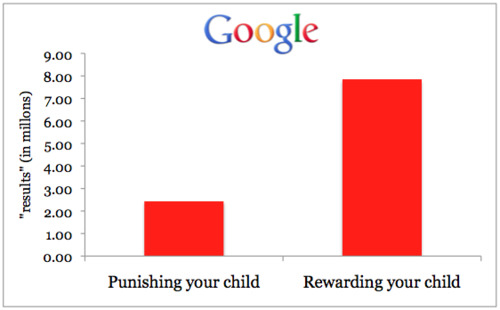
Just for a bit of fun, I wanted to know how much information there is out there about popular parenting topics.  One way to measure this now is simply to see how many websites provide information on whatever it is you want.  Its a way to see how much interest there is in something: Google it.  

Here are some results from a recent Google search I did in your honor.  The phrases below the columns are what I “searched.”  What I think it shows is

1) There is a lot…A LOT out there

2) There is a lot out there because the interest and thirst for the knowledge is great

3) If you are “Googling” for help or information on these topics…you are not alone.


Looks like you have company…